Search This Entire Blog

Saturday, February 24, 2018

The Detroit Curling Club was once an Auto Plant

May 15, 1913.  Studebaker designates The Club as Plant #14.  The Studebaker Corporation has leased the Detroit Curling Club building on Forest Avenue as a storage warehouse for radiators, coils, springs and other supplies.  This is the fourteenth building that the Studebaker Corporation has acquired in the capital of automobiledom.


This arrangement was only for the non-curling months, since we know there was curling in the building in the winter of 1913-14.

Neither rhyme nor reason.
Angus MacTavish


Saturday, February 17, 2018

How Corny is a Corn Broom?

There is no corn in a curling corn broom.  The fibers in a corn broom are from a variety of sorghum.  This became such a popular broom making material in the early 1800s that people started calling the plant:  Broom-Corn.  The pictures below show a sorghum plant (about 10 feet tall); harvested fibers waiting to go into a broom and a finished curling broom.


There were two basic styles of corn broom.  The first has a skirt or apron of shorter fibers.  The apron serves two purposes:  1) to keep the lower fibers together during the power-stroke across the ice and 2) to act as a spring to return the lower fibers to center before the next power-stroke on the ice (see photo).


The second type of corn broom did not have an apron but rather a strap of leather or plastic inside the center of the bundle of fibers.  This center “spring” serves the same functions as the skirt.  Additionally, a string or band surrounding the fibers also acts to keep the entire bundle together during the sweeping process.


The sound made by these brooms was both musical and magical.  I am sorry that the youngsters learning the game today (and within the last 20 years) will never experience an arena full of the sounds of straw and leather slapping the ice or the poetry of seeing two sweepers in perfect harmony.  I found one video on YouTube that has the sound of one broom – try to imagine 12 or more brooms banging away at once.  At YouTube you can search for “The fine art of using a corn broom to curl” or Click-Here.


During the 1960s and 70s The Club purchased corn brooms to be used by guests and new members.  As these brooms aged, one by one they found their way out of The Club and into the trunk of many a member’s car – they were handy for clearing the snow off the car!  I know the location of only one of these brooms, but I would bet that there are a few more out there.


Hurry Hard!

Angus MacTavish
Knight of The Royal Order of The Broom

Thursday, February 8, 2018

Can Curling Help! The Beatles

Almost fifty-three years ago (1965), the Beatles’ movie Help! was released.  It was a whacking film about?…   about?…   well, I don’t really know.  It starred the Beatles and it was sure to be a box office success.  The important portion of the movie to us is the curling scene.  More accurately, the Beatles goof around with curling stones and brooms.  George slides a curling stone towards John and Ringo who comically chase after it and sweep.  Paul meanwhile appears to be more interested tidying up the ice.


Nearby, a mad scientist is preparing a bomb inside a curling stone and sets a timer.  He offers the ticking and smoking curling stone to George who delivers it toward Ringo.  As Ringo sweeps, George realizes it’s a bomb – “A fiendish thingy!”  He, John and Paul drag Ringo away from the bomb and run.  The bomb explodes leaving a gaping hole in the ice and a swimmer appears – asking for directions to the White Cliffs of Dover. 

It doesn’t connect at the dots…

Just a little confused,
Angus MacT.


Tuesday, December 19, 2017

Overheard at the Old Rookery One Night

One of the etiquette rules of curling essentially states “if you can’t say something nice, then don’t say anything at all”.   I remember a night, a long time ago, when the keen but cranky old skip, Cameron McManus, a true son of The Land of Cakes, lost a game owing to the bad play of one member of his rink.

McManus turning on the under-performing player with a sardonic grin, the Scotchman remarked:  “Eh, mon, you’ll ne’er mak’ a curler in this world and you’ll ne’er see ice in the next”.

Old nimble-chops,
Angus MacTavish

Tuesday, December 12, 2017

Under The Lights

Did you curl one night this past week?  Were you warm enough?  Could you see the entire rink with ease?  One-hundred thirty-one years ago, the members of The Club had it a little more difficult.


Tuesday December 21, 1886.  The evening was a chilly 30 degrees; winds out of the NW with light snow falling.  DCC members were preparing for the first game of curling ever played in Detroit under electric light.


The City of Detroit had contracted the Brush Electric Light Company to build 122 electric light towers to illuminate Detroit.  These towers were 150 feet high with a ring of electric arc lights at the top.  Their lights were as bright as the moon; sometimes called "moonlight towers."  One of these towers was located at a corner of the Athletic Field near Woodward Avenue and Canfield Street.  

 Moonlight Tower circa 1900
Detroit – Old City Hall

This night it was a hotly contested battle.  To those who are initiated into the spirit of the royal old Scotch sport, it was an intensely interesting spectacle.  The play of rink No. 1 was directed by John Williamson, while his son, Robert Williamson, called the shots for rink No. 2.   The former’s men were C.T. Cole, J.H Kenn and A.W. Baxter; while the latter’s were J. Feuder, George O. Begg and T. Williamson. 

Rink No. 1 found itself entitled to that designation by defeating No. 2 by a score of 16 to 13, the game lasting three hours.

And so, to bed, perchance to dream,
Angus MacTavish


Thursday, November 30, 2017

When They Played Polo at The Curling Club

Polo matches were the rage from about 1884 through 1915 throughout Detroit and around the state.   On a good weekend, you could find three or four games being played somewhere in the city.  The players did not ride ponies, but rather skates – roller skates.  The game was similar to ice hockey.  It was played by twelve men, six on each side, though it could be played by ten on a side.  One player on each team guards the goal.  A referee governs the contest.  He calls “play” and “time” when the game is begun or suspended.  The referee also decides what constitutes foul play.


During November 1890, The Detroit Curling Club had installed a level wooden floor over the ground in order to make ice with less water and easier to freeze.  The floor was 85 feet wide by 160 long.  At the time the members of the Detroit Skating & Curling Club hoped that the new flat and level floor would attract roller skaters.  It did – Polo Players.  The Club boasted at least two teams that played at Forest Avenue and toured around the state.  The Detroit Free Press reported on February 7, 1892: “An exciting game of polo was played by well-matched teams of The Detroit Skating & Curling Club.  A victory was gained by the Reds over the Blues by a score of 7 to 0.”  


Roller Polo Facts:  
* The first game was played in 1878 in London, England.  
* The US National Polo League was formed in Dayton, Ohio in 1882.  
* Roller Hockey (what the game is called today) was an exhibition sport in the Summer Olympics in Barcelona, Spain in 1992. 

Locally, the game is played in Shelby Township.  If you are interested checkout the Little Caesars Roller Hockey League at the Joe Dumars Field House.  www.lcrh.info

Can “Polo Night in America” on NBCSN be far behind?

What fools these mortals be…
Angus MacTavish


Wednesday, November 1, 2017

The Color of Curling Stone Handles

A Club member asked:  "Have the handles on the curling stones always been red and yellow?" Secondly:  "Why are they red and yellow?"

Red and White handles were the most popular.  I am told that someone somewhere did a study to determine which colors people were able to distinguish at a distance.  Red & White were predominant.  White has been replaced by Yellow (or Maize) because it shows up better on TV coverage against the white ice background. 


Full Lexan (plastic) handles have been around since the mid-1970s.  Prior handles were chrome plated iron.  They had the capability to change a plastic colored insert to a variety of colors.  Secondly the leather or plastic washer between the handle and the stone could be a different color.


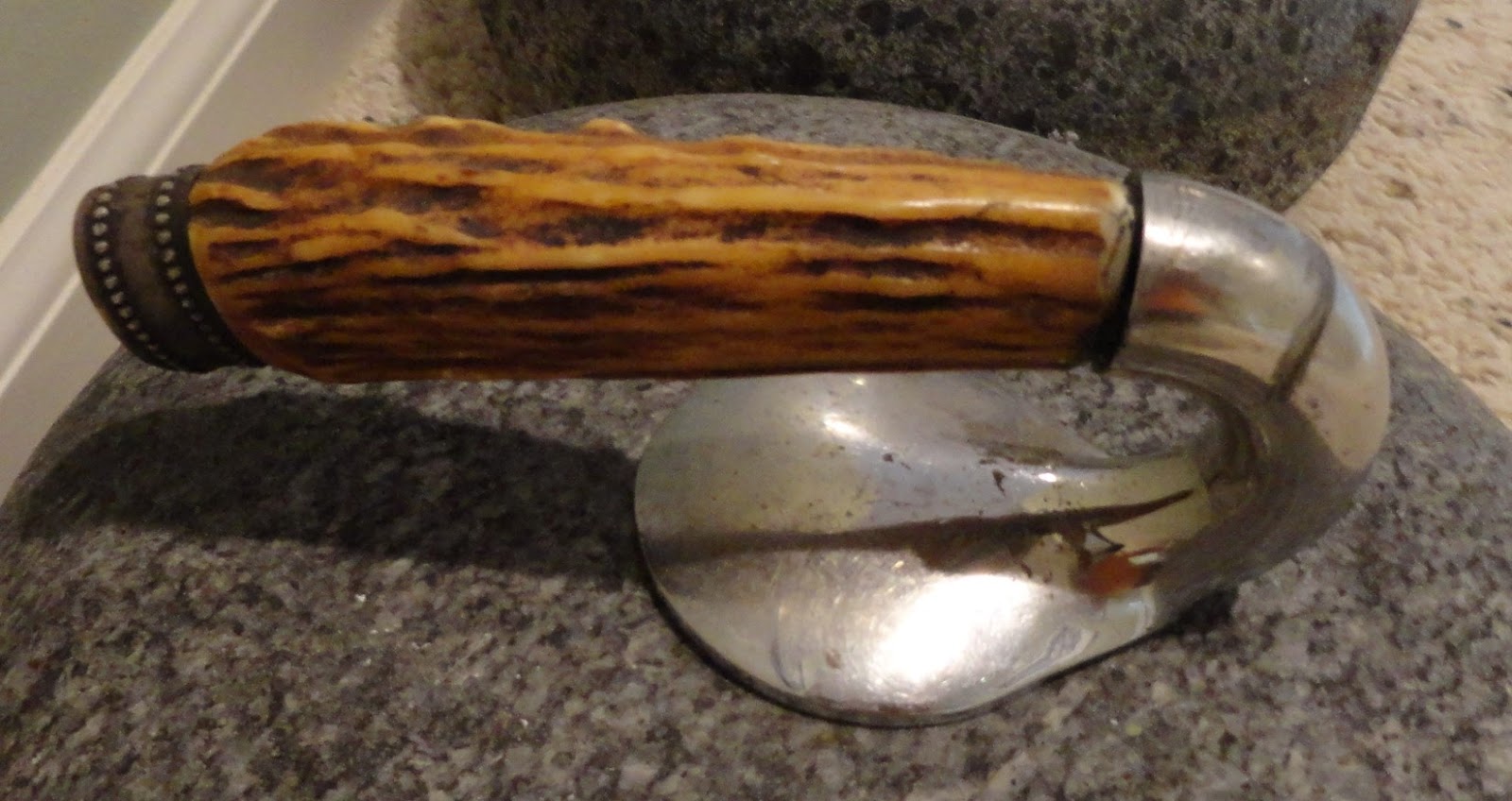
Let us not forget that prior to the 1940s most people owned their own pair of stones.  Identification could be engraved wooden hands; decals on the rock or something homemade - like the deer antler handle below.


When we go back further in time, we find that brass handles had little means of identification.  Though at in this time-frame ‘my pair’ probably differed quite a bit from ‘your pair’.  Iron stones have the advantage that they can be repainted from time to time.


The oldest stones were handmade.  You could just chisel your name or initials into the rock.


Another means to individuality, is to tie a ribbon or a bow on the handle.  This was very popular at ladies’ and mixed bonspiels in the 1950s thru the 1980s.

But wait!  The only reason stones are identified is for the spectators.  The skips can tell which is which and whose is whose.  The person delivering the next rock doesn’t really need to know.  The skip says:  “Take this out”; “Tap this stone”; “Come around this one”.  As the thrower I shouldn’t care whose stone it is.  I should just do what the all wise and powerful skip tells me to do.