Search This Entire Blog

Thursday, November 30, 2017

When They Played Polo at The Curling Club

Polo matches were the rage from about 1884 through 1915 throughout Detroit and around the state.   On a good weekend, you could find three or four games being played somewhere in the city.  The players did not ride ponies, but rather skates – roller skates.  The game was similar to ice hockey.  It was played by twelve men, six on each side, though it could be played by ten on a side.  One player on each team guards the goal.  A referee governs the contest.  He calls “play” and “time” when the game is begun or suspended.  The referee also decides what constitutes foul play.


During November 1890, The Detroit Curling Club had installed a level wooden floor over the ground in order to make ice with less water and easier to freeze.  The floor was 85 feet wide by 160 long.  At the time the members of the Detroit Skating & Curling Club hoped that the new flat and level floor would attract roller skaters.  It did – Polo Players.  The Club boasted at least two teams that played at Forest Avenue and toured around the state.  The Detroit Free Press reported on February 7, 1892: “An exciting game of polo was played by well-matched teams of The Detroit Skating & Curling Club.  A victory was gained by the Reds over the Blues by a score of 7 to 0.”  


Roller Polo Facts:  
* The first game was played in 1878 in London, England.  
* The US National Polo League was formed in Dayton, Ohio in 1882.  
* Roller Hockey (what the game is called today) was an exhibition sport in the Summer Olympics in Barcelona, Spain in 1992. 

Locally, the game is played in Shelby Township.  If you are interested checkout the Little Caesars Roller Hockey League at the Joe Dumars Field House.  www.lcrh.info

Can “Polo Night in America” on NBCSN be far behind?

What fools these mortals be…
Angus MacTavish


Wednesday, November 1, 2017

The Color of Curling Stone Handles

A Club member asked:  "Have the handles on the curling stones always been red and yellow?" Secondly:  "Why are they red and yellow?"

Red and White handles were the most popular.  I am told that someone somewhere did a study to determine which colors people were able to distinguish at a distance.  Red & White were predominant.  White has been replaced by Yellow (or Maize) because it shows up better on TV coverage against the white ice background. 


Full Lexan (plastic) handles have been around since the mid-1970s.  Prior handles were chrome plated iron.  They had the capability to change a plastic colored insert to a variety of colors.  Secondly the leather or plastic washer between the handle and the stone could be a different color.


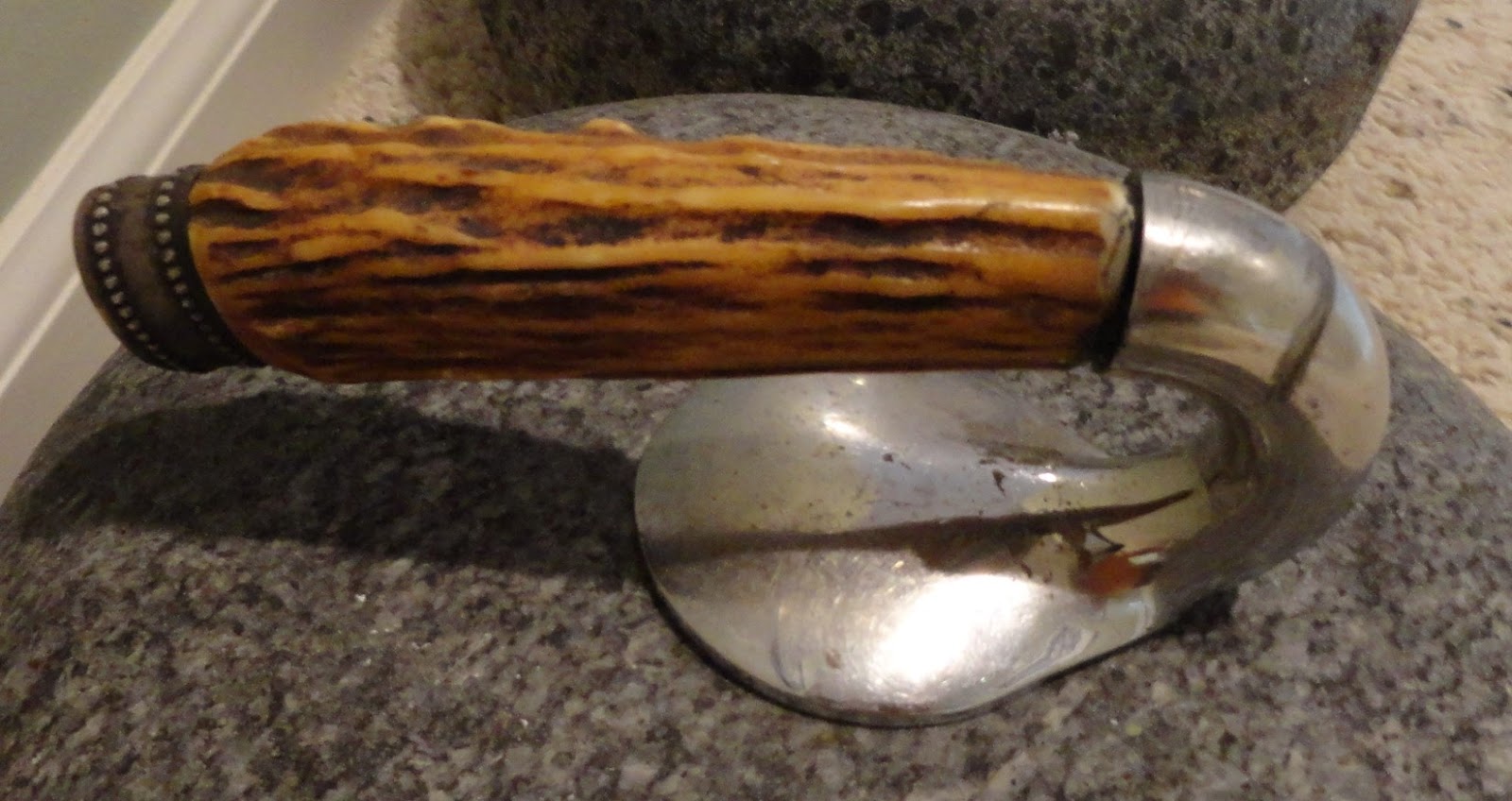
Let us not forget that prior to the 1940s most people owned their own pair of stones.  Identification could be engraved wooden hands; decals on the rock or something homemade - like the deer antler handle below.


When we go back further in time, we find that brass handles had little means of identification.  Though at in this time-frame ‘my pair’ probably differed quite a bit from ‘your pair’.  Iron stones have the advantage that they can be repainted from time to time.


The oldest stones were handmade.  You could just chisel your name or initials into the rock.


Another means to individuality, is to tie a ribbon or a bow on the handle.  This was very popular at ladies’ and mixed bonspiels in the 1950s thru the 1980s.

But wait!  The only reason stones are identified is for the spectators.  The skips can tell which is which and whose is whose.  The person delivering the next rock doesn’t really need to know.  The skip says:  “Take this out”; “Tap this stone”; “Come around this one”.  As the thrower I shouldn’t care whose stone it is.  I should just do what the all wise and powerful skip tells me to do.


Monday, October 16, 2017

Something I Found While Looking for Something Else

Absolutely nothing to do with curling…

The Canadian officials in the Ottawa Finance Department admitted that the picture on the face of the new Canadian four-dollar bill is that of the American “Soo” lock.  The Finance Department sent a request to Montreal for a picture of the Canadian lock at the Sault.  In reply they received a picture of the American lock and used it.  The officials say they were misled by noticing the Canadian Pacific steamer Athabasca in the lock and assumed in consequence that the picture was all right.  The department of railways and canals was not consulted in the matter.


 The 1902 Canadian $4 bill with King Edward VII and Queen Alexandra.

Good Curling,
Angus MacTavish

BTW – Does anyone know of another word for Thesaurus?


Sunday, July 23, 2017

I’ll have Chicken Mulligatawny

If you are a Detroiter, you know about Sander’s Hot Fudge and other Sander’s candies, but you must be of a certain age to remember the Sander’s Lunch counters.  At one point, there were over 100 stores throughout metro Detroit most of them with Lunch counters.  The menu was also your place-mat and they printed a new one each weekday. 


On the back of the menu different articles were printed.  On this January 31, 1946 menu was an article about The Detroit Curling Club:  “Curling is a Friendly Game - For three quarters of a century, the fine old Scottish game of curling has had its devoted circle of enthusiasts in Detroit.  For sixty years, they have had a club of their own, often the scene of jolly Bon Spiels [sic] as the members entertain clubs from neighboring Canadian cities.


“The Detroit Curling Club on West Forest Avenue is affiliated with the Ontario Curling Association, with whose members it visits back and forth for friendly games throughout the season.  Its rink is made of artificial ice and carefully maintained so that the game can be played all winter long.

“While not a fast game to watch, curling holds a fascinating lure for players.  In contrast with other winter sports, it does not depend upon power and speed, but rather upon accurate judgment of distances and exact control.  Every throw of the stone is a precision operation.”

Interesting how you can find things about the history of our Club in the most unusual sources.

Lifeisoneendlesssheetofice,

Angus MacTavish

Monday, April 3, 2017

‘RINK’ – Such A Common Word Today

Ask anyone on the street:  What is a “rink”?  They will describe an ice skating rink or perhaps roller skating, but the word actually originated from the sport of Curling.


The Webster’s Dictionary in 1895 did not contain the word “rink”.  The Webster’s 1905 edition does contain the word “rink”, but it redirects you:  “Rink see Ring”.  Under “ring” we find:  “Ring - a circle, circular line or anything in the form of a hoop; an inclosure [sic] for games … Rink, n Origin:  course for the game of curling; a covered sheet of ice …”

In the 18th century the meaning of "rink" was "a space of ice marked out for a curling match.”  By the mid-19th century, "rink" had acquired its modern day association with ice- or roller-skating. 

The roots of "rink" are a bit tangled, but its closest relative is probably the Middle English "renc," meaning "racecourse," derived from the Old French "renc," meaning "line, row or rank." (The related Old French word "ranc" gave us our modern English "rank").  It is also probable that both "rink" and "rank" go back to the Germanic root that produced the English word "ring" meaning "circle."

How did “rink” also become a word to describe a curling team is something we will discuss in a future article.

I shall see my rank rink at the round rink,
Jocko MacTartan

Thursday, March 2, 2017

The Curling Delivery "Stick"

Is the curling delivery “stick” a relatively new invention?  Nope. 


The idea of curling on skates appears to be the height of absurdity to curlers, but do not be amazed when I tell you it once was seriously proposed to play the game on skates.

In the late 1700’s the idea of curling on ice skates was presented by the Duke of Athole (excuse me?).  He proposed using a long cue or pole to hold the handle of the curling stone.  The player on skates would back-up 10 to 12 yards behind the Tee, “then advancing rapidly, with an eye on the object to be accomplished, and when reaching the tee giving the stone the requisite impulse – imitating, after a fashion, the push shot in the game of billiards.”  When the game is played in this method it was said to be exciting and invigorating.

Fortunately, Tcurling on skates was not pursued for long, but “the long cue or pole” did return to curling to allow people unable to get into the hack the ability to deliver a stone.

Hey – I do not make this stuff up!

Toodle-oo,
Angus MacTavish

Wednesday, February 22, 2017

Let’s Twist Again

Every curler has been asked: “Why is the game called Curling?” and we all answer: “When you deliver the stone you put a slight turn on the stone so it “curls” as it goes down the ice”.   Wrong answer.  The game was played for over 200 years and the players did not purposely put a turn on the stone.

Many years ago, I was able to conduct an experiment on a natural ice pond with 3 different types of curling stones:  wooden; flat-soled and an early concave stone.  When trying to deliver a stone on natural ice (meaning: there are cracks, biases, other imperfections and no pebble) the first thing you find is that it is very difficult to throw the stone with any distance.  If you get the chance, try to deliver a stone after a fresh flooding or after a major Ice-King scraping before the pebble is applied.

The second thing you notice is the lack of “curl”.  Without the pebble the stone does not ‘bend’ in any repeatable fashion.  Moreover, the imperfections in a natural ice surface can change or increase the ‘bend’ remarkably and unexpectedly.  

In the early-1800’s many groups were taking credit for inventing the Twist.  There was the Fenwick Twist, the Canadian Twist, the Kilmarnock Twist, the Timothy Twist and others.  The earliest record we found of curlers using the Twist comes from Mr. John Fulton of Fenwick, Scotland: “If I recall aright the first year of the century [1800] was the year of its birth.  That year was memorable for the length and severity of its winter…  It was told, that day after day a few of the Fenwick players were never absent from a small loch in the parish.  Here they met and amused themselves as best they could, playing every imaginable shot.  While thus engaged, they observed the effect of the rotary motion on a stone…so they set themselves up to give the stone one or the other twist.”  The Fenwick curlers went on to defeat their opposition repeatedly with their new-found skill and passed that knowledge to the neighboring parishes.

The Kilmarnock Treatise on Curling (1828) offers these definitions:  Outside Twist – Lift the stone…swing it towards the side, outward and forward, making it describe a semicircle.  This is done with the shoulder and elbow joints, without turning the wrist much.  Inside Twist – Lift the stone as before; and as the swing forward is given, bring the elbow close to the body, turning the wrist fully in delivery.

Later the Twist was called the Out-Sweep and the In-Sweep.  Today we call it the Out-Turn and the In-Turn.

So, how did the game get its name?  The oldest books and modern day books we have researched seem to agree that the word Curl is from the German word Kurzweil:  an amusement; a game.  The word Curling from Kurzweillen:  to play for amusement.

Gute Kurzweillen,
Angus VonTavish